What Size Trade Show Booth Do You Need for Your Business?
How to Choose the Right Trade Show Booth Size
Many exhibitors default to either the smallest space available to control costs or the largest space they can justify for visibility. Both approaches miss the point. The real objective is to choose a booth footprint that allows your team to conduct meaningful interactions with prospects while presenting your products or services in a clean, structured environment. A booth that is too small restricts conversations and demonstrations, while a booth that is too large can dilute activity and waste resources.
Selecting the right trade show booth size is not merely a matter of budget or visibility. It is a strategic decision that directly influences how effectively your team engages and moves buyers into the sales pipeline. The size of your booth should ideally support the way your business sells, whether you’re planning to buy a custom booth or exploring turnkey exhibit rental options for different trade shows.
What to Consider When Choosing a Trade Show Booth Size
Booth size sets the ceiling on almost everything else. It shapes your budget, your traffic flow, how many staff you can fit, and what visitors actually remember after the show. Before you lock in a 10×10 or scale up to a 20×20, run through these factors:
- Your budget (and what it really has to cover): Size doesn’t just affect the build; it also drives shipping, drayage, labor, electrical, and graphics. Price the full picture before you commit, not just the booth itself.
- What you want from the show: A booth built for lead capture looks different from one built for executive meetings or live product demos. Define the goal first; size follows.
- Expected foot traffic: Check the show’s attendance numbers and the pace of past editions. A high-traffic show with tight aisles needs more square footage just so visitors don’t get pushed past you.
- Number of staff on the floor: Plan for roughly 50 square feet per person working the booth. Pack in more and the space starts to feel like a checkout line.
- Product and demo footprint: Large equipment, monitors, sampling stations, and live demos eat space fast. Map out what physically needs to fit before you settle on dimensions.
- Private meeting space: If your sales team plans to close deals on the floor, you’ll need a closed-off meeting room or semi-private corner. That alone can push you from a 20×20 to a 20×30.
- Storage: Backstock literature, branded giveaways, coats, and personal bags all need somewhere to live. Skip this step and your booth turns into a back-of-house mess by day two.
- Booth location and configuration: A corner booth opens up on two sides. An island opens up on four. The same square footage feels different depending on where it sits on the floor plan, so factor location into your size decision.
- Show rules: Most shows cap booth height, hanging signs, and rigging based on your booth size. Read the exhibitor manual before you commit; the limits often shift between a 20×20 and a 20×30.
Trade Show Booth Sizes and Layout Options
The exhibit industry generally organizes booth footprints into four tiers. Here’s how each size can be mapped to real-world business needs:
 10×10 (100 sq ft) — The Classic Inline Booth
The industry standard entry point. Ideal for startups, first-time exhibitors, and businesses testing a new show. Supports 1–2 staffers and works best for service-based companies, SaaS products, or brands focused on conversation rather than display.
Open on one side only, so messaging and layout must work hard to pull traffic in.
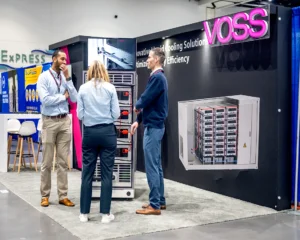
10×20 (200 sq ft) — The Double Inline
A step up that gives growing brands room to breathe. This size supports a small product display alongside a dedicated conversation zone.
Well suited for companies with 2–3 product lines, a demonstration component, or a need to separate lead capture from deeper sales discussions. Common among mid-market B2B companies and regional exhibitors.
 20×20 (400 sq ft) — The Island Booth
Open on all four sides, the 20×20 is where exhibiting becomes a branded experience. This footprint supports multiple engagement zones like a demo area, a meeting nook, and high-impact signage simultaneously.
Typically used by established companies with complex offerings, multiple buyer personas, or a need to project authority on a competitive show floor. Staffing of 4–6 is recommended.
 20×30 to 30×30 (600–900 sq ft) — The Large Island
At this scale, exhibitors can create distinct environments within a single booth — product launch areas, private meeting rooms, live demo stages, and lounge zones.
Suited for large companies, manufacturers showcasing equipment, or brands launching new product lines at flagship industry events. Expect to staff 6–10+ representatives to keep every zone active and engaged.
 40×40 to 50×50 (1,600–2,500 sq ft) — The Trade Show Destination
Reserved for industry leaders and category-defining brands that use trade shows as a primary demand generation channel. These footprints function as fully immersive brand environments, complete with theater seating, hospitality stations, multi-product demo circuits, and executive meeting suites. The investment is significant, but so is the impact: a well-executed 50×50 booth becomes a destination in itself, drawing attendees from across the show floor.
Not sure which size fits your next show? Use the Exponents Booth Configurator to explore layouts and sizes matched to your goals — and see exactly what’s possible at every footprint.
Start With Your Sales Strategy, Not Your Square Footage
The most reliable way to determine the right booth size is to evaluate what must happen inside the space during the event. Every square foot should support a specific purpose, whether that is product demos, qualified sales discussions, lead capture, or scheduled meetings with buyers and partners. If your booth strategy focuses primarily on short discovery conversations and initial introductions, a compact space can perform effectively. However, if your team needs to conduct demos, display multiple solutions, or hold deeper sales conversations, the booth must accommodate those activities without crowding or disrupting visitor flow.
The key consideration is operational capacity. Your booth should comfortably support the number of simultaneous interactions your team expects to manage throughout the day. When conversations overlap, traffic builds quickly. Without adequate space, prospects often leave before engaging, and your team spends more time managing congestion than progressing sales discussions.
Know Your Crowd: Volume vs. Quality of Engagement
Trade show booth size should reflect expected traffic patterns and the level of engagement required with each visitor. Some companies prioritize high-volume lead capture, while others focus on fewer but more qualified conversations.
A booth designed for high visitor throughput must provide clear entry points and natural traffic flow so prospects can approach, engage, and move through the space without hesitation. When visitor flow becomes unclear or congested, engagement drops and valuable opportunities are lost. For exhibitors targeting high-value accounts, the booth may also need areas that support longer discussions or private conversations. Buyers evaluating significant investments often require more detailed exchanges than a quick interaction on the aisle can provide.
Your Team Needs Space to Work, Not Just Stand
Another often overlooked factor is staffing. The number of representatives working the booth should influence the space you choose. A booth must allow your team to interact with visitors without physically competing for space. When representatives are crowded into a small area, conversations become rushed and uncomfortable for both staff and prospects. Conversely, placing a small team in an oversized booth can make the exhibit appear inactive, which discourages attendees from stopping.
The most effective booth environments strike a balance between energy and accessibility. Visitors should immediately see that something is happening in the booth, but they should also feel comfortable entering and starting a conversation.
Bigger Isn’t Always Better. Smarter Is
While booth size contributes to brand visibility, it should never be the sole driver of the decision. Visibility is ultimately created through design clarity, messaging, and the activity happening inside the booth.
A well-designed exhibit that efficiently uses its space often attracts more meaningful engagement than a larger booth that lacks structure. Strategic layouts and clear product messaging can make a booth feel open, professional, and inviting regardless of its footprint. This is where a thoughtful trade show booth design becomes critical, ensuring that every part of the space supports visitor engagement and brand storytelling. For many exhibitors, working with a local trade show booth rental company allows them to scale their presence appropriately for each event.
The Right Booth Size = Better ROI, Every Time
Ultimately, the best booth size is the one that allows your team to operate efficiently while delivering a strong, professional presence on the show floor. The goal is not to secure the largest footprint available, but to create an environment where prospects can easily understand your offering, interact with your team, and move toward the next step in the buying process. Businesses that evaluate booth size through the lens of sales activity, product presentation, visitor engagement, and team performance consistently achieve stronger outcomes from their trade show investments.
When these factors are considered together, the right booth size becomes much easier to identify. For organizations seeking efficiency and simplicity, partnering with a turnkey trade show booth rental partner can further streamline the exhibiting process while ensuring the booth size and layout support their overall event goals.
Ready to find the right fit? Browse booth options by size and style and start building your next exhibit today.
Related Posts
New Gaylord Pacific Resort & Convention Center in Chula Vista: What Exhibitors Need to Know